
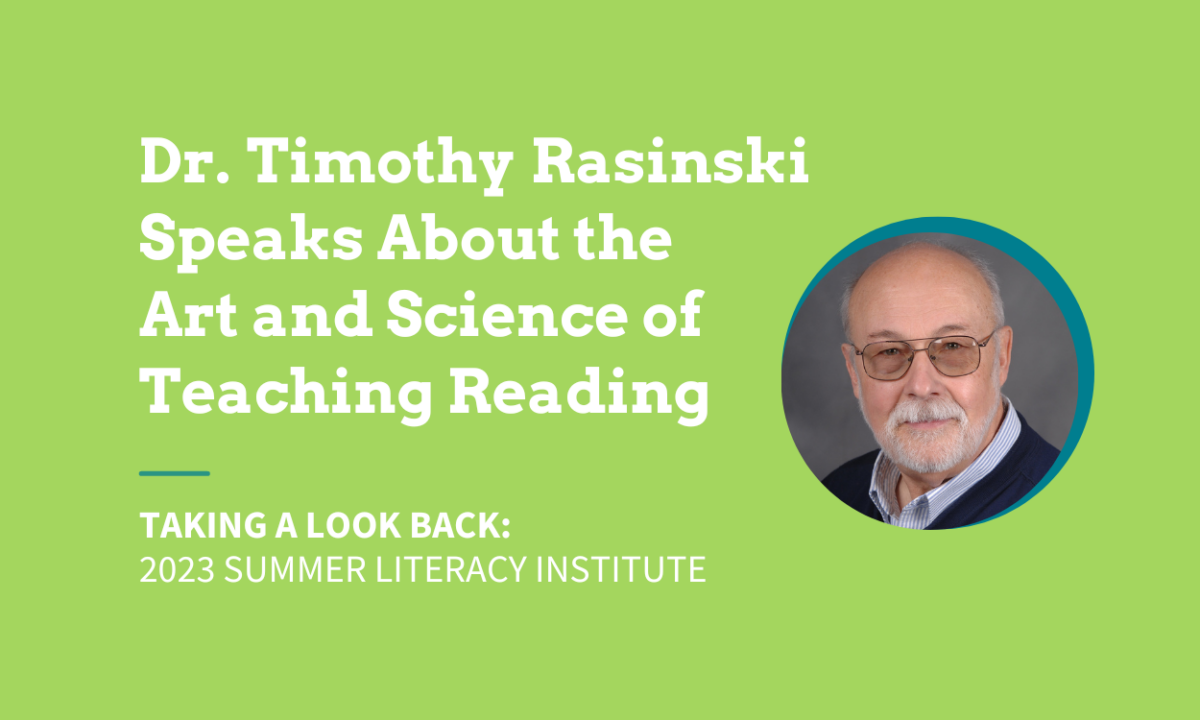
Researcher and author, Dr. Timothy Rasinski, kicked off the Center for Reading Recovery and Literacy Collaborative’s Summer Institute by helping educators think about The Art and Science of Teaching Reading.
Rasinski spoke of how the teaching of reading is both a science and an art. Teachers can develop children’s phonemic awareness, understanding of morphology, knowledge of meaningful word parts (i.e. Greek and Latin Roots), automaticity, and fluency in a fun, artful, and authentic way:
- Real songs, nursery rhymes, and other poetry help children play with sounds and develop phonemic awareness.
- Word games help children understand morphology and meaningful parts of words.
- Children learn about prosody and develop fluency when they rehearse for performance reading of real text.
Also of great importance, is to remember that prosody and comprehension go hand in hand. When children read with expression and pausing, it enhances their understanding of their reading. Rasinski shared research-based techniques for teaching fluency and prosody:
- Modeled Fluent Reading
- Assisted Reading
- Wide Reading Practice
- Repeated Readings
These teaching methods are fun, engaging, responsive, and supported by science. They create successful reading experiences which children can build using authentic texts. Rasinski encouraged teachers to teach scientifically but to do so in an artful way and to ask themselves, “How can you create artful and scientific curriculum?”

Like what you learned? Dive deeper into the essential elements of teaching phonics, spelling, and word study and come away prepared to address the needs of your students with these upcoming offerings!
- Word Study: Teaching Phonics, Vocabulary, and Spelling in Grades K-8
July 31 – August 4, 2023 - What Teachers Need to Understand About the Alphabetic System: Phonics & Spelling
On-Demand Course