


“I started with paper, pencil, and binoculars.” — Jane Goodall
A Boy and His Binoculars
Recently, while out walking, I noticed a little boy, maybe four or five years old, making his way along the trail ahead of me. Every few steps, he stopped, lifted the binoculars hanging from around his neck, and scanned the trees and brush beside the path. Each time, as he paused, his mother patiently waited beside him.
Mother and son settled into a rhythm of walking, pausing, and observing as they moved down the trail. I was captivated. When something rustled in the brush, the boy froze and scanned carefully. When a bird darted to another branch, he quickly raised the binoculars and tracked its movement.
Watching his interest in the world around him, I found myself wanting to hand this little naturalist a notebook and pencil to go along with his binoculars and curiosity. The scene reminded me that throughout history, curious people have turned to notebooks to make sense of what they noticed.
A History of Thinking on Paper
As I continued to watch this boy, my thoughts turned to The Notebook: A History of Thinking on Paper by Roland Allen, which traces how thinkers throughout history have used notebooks to capture observations, questions, discoveries, and ideas. Explorers, artists, scientists, writers, and mathematicians all turned to notebooks as tools for learning and creative thought.
Whether commonplace books, sketchbooks, logs, field journals, or reading notebooks, these collections reveal a common human impulse: to notice, record, and make meaning from life. The more I thought about notebooks, the more I realized they have long accompanied curiosity and discovery.
Long before digital tools, naturalists like Charles Darwin relied on notebooks to organize observations and develop ideas. Darwin filled notebooks with geology notes, species observations, travel records, and theoretical sketches—including his “I think” journal entry about a sketch of an evolutionary tree. This was not simply a record of his learning; it was a place where his thinking unfolded.
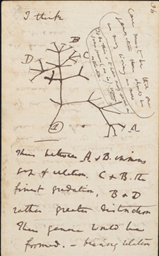
Charles Darwin’s “I think” sketch from Notebook B (1837), where he began mapping early ideas about evolutionary relationships. Public domain image via Cambridge University Library / Darwin Online.
This same opportunity — to shape thinking through writing, sketching, and observing — should belong to students, too.
A Place to Think
Classrooms should protect and nurture curiosity like that of Darwin, da Vinci, and Goodall. One simple but powerful way teachers can nurture students’ curiosity is through notebooks. In classrooms, notebooks are not merely places to record learning; they are places where learning takes place.
Notebooks create space for students to collect questions, sketches, observations, discoveries, and evolving ideas. Their pages preserve rough drafts, crossed-out thinking, and changing theories. Real learning is rarely neat or linear. In notebooks, students can explore without the pressure of perfection.
Imagine a classroom where every child keeps a notebook for thinking and creativity: sketching moon phases, recording questions about ants on the playground, collecting unfamiliar words from books, or designing inventions inspired by Leonardo da Vinci’s famous notebooks filled with sketches, questions, and ideas.
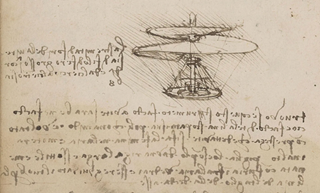
Leonardo da Vinci, “Aerial Screw” sketch (c. 1485–1490). Public domain image via Wikimedia Commons.
The form notebooks take can vary widely depending on the kind of thinking students are doing. Notebooks invite endless possibilities. Students might record:
- observations and sketches about nature
- questions and responses to their reading
- mathematical problem-solving and reasoning
- sketches and drawings
- interesting language
- writing ideas
- diagrams of inventions, prototypes, and creative plans
With these ideas in mind, notebooks become more than assignments or organizational tools. They become places where students cultivate habits of attention, reflection, and creative thought. Almost anything worth noticing belongs in a notebook.
A Place to Slow Down and Notice
Just as importantly, notebooks encourage a different pace of learning. They invite students to slow down and linger with ideas long enough to sketch them, describe them, question them, and return to them. In a culture of quick answers, constant scrolling, and the temptation of letting technology think for you, notebooks create space for patience, thoughtfulness, and creativity.
They teach students to pay attention to ordinary things that might otherwise go unnoticed. This kind of attentive observation is what connected naturalists like Jane Goodall to the world around them.
Jane Goodall entered the forests of Gombe with binoculars, paper, and pencil. By patiently observing and recording the daily lives of chimpanzees, she transformed ordinary moments into extraordinary discoveries.
Perhaps this is one of the most important purposes of education: teaching children how to pay attention.
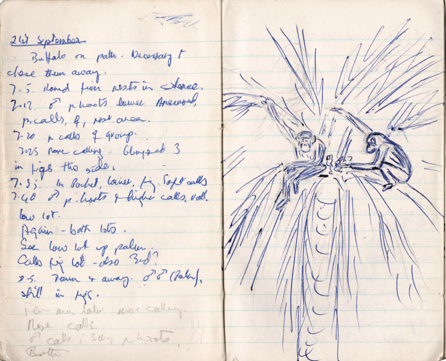
Jane Goodall, Notebook pages, circa 1961. Public domain image via National Geographic.
(Click on the Goodall notebook pages and watch a brief Instagram video that shows Jane Goodall with her notebook and binoculars.)
More Than Another School Supply
Notebooks—journals, sketchbooks, diaries, field notes—safeguard thoughts, capture observations, and preserve curiosities. They help make meaning from experience. In many ways, notebooks are simple tools that support something much larger: the development of attention, memory, and wonder.
I still picture that little boy stopping every few steps to scan the trees beside the trail. His curiosity felt unhurried, genuine, and filled with possibilities. Schools should protect this kind of attention. A notebook may seem like just another school supply, but in the hands of children, it can serve as a lifelong companion for learning, thinking, and discovery.
References
Allen, R. (2024). The notebook: A history of thinking on paper. Biblioasis.
Cambridge University Library / Darwin Online. (n.d.). Charles Darwin’s “I think” sketch (Notebook B, 1837).https://darwin-online.org.uk/
National Geographic. (2025, December 1). Jane Goodall, notebook pages circa 1961.https://www.nationalgeographic.com/history/article/jane-goodall-life-career-legacy-chimps
Wikimedia Commons. (n.d.). Leonardo da Vinci, Aerial Screw (c. 1485–1490). https://commons.wikimedia.org/w/index.php?search=da+Vinci%2C+aerial+screw&title=Special%3AMediaSearch&type=image
JaneGoodallCan. (n.d.). Jane Goodall in the field with notebook [Instagram video]. https://www.instagram.com/reels/DRR-d8WiiTh/