

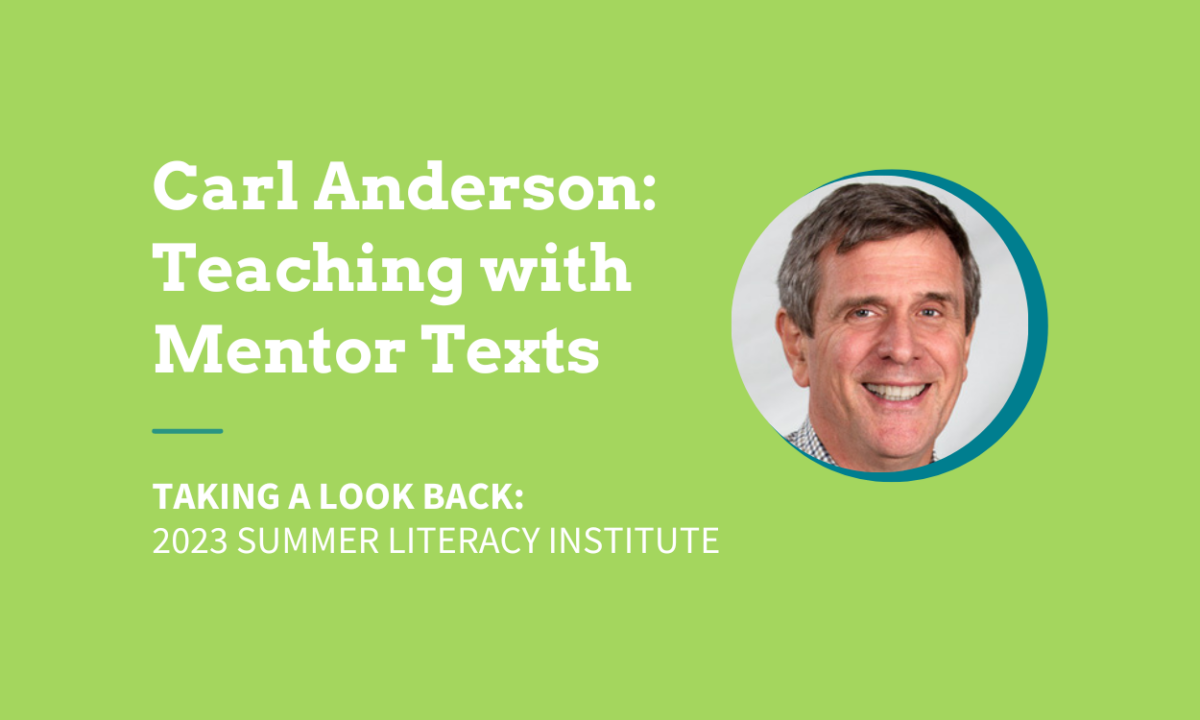
Last week, we welcomed Carl Anderson to our Summer Literacy Institute to speak about his new book, A Teacher’s Guide to Mentor Texts, K-5. Carl spoke about the importance of using mentor texts for writing instruction and described how to use them successfully in whole group, small group, and individual writing conferences.
A well-crafted text can be used to show children how they can use crafting techniques in their own writing. In this way, teachers can be descriptive about what they want children to learn how to do as writers because they are able to show many well-crafted examples.
Craft refers to the decisions made by writers regarding:
- Focus
- Structure
- Detail
- Voice
- Conventions
A mentor text can be:
- A published text
- A text created by the teacher
- A student’s text
When it comes to teaching with mentor texts, Anderson says, “It’s not magic, it’s infrastructure!” Here is what he recommends:
Select a stack of mentor texts for your unit of study.
While a few mentor texts are better than none, Anderson recommends gathering 3-5 examples of texts for your unit. They should be clear, high-quality examples of the type of writing the children will study, and represent the students in your class, and the world. Writing is an act of making decisions, so you will want to be able to show students several examples of crafting moves they may consider to apply to their own writing.
Get to know the mentor texts.
It is essential to be very familiar with your selected mentor texts by reading each one and systematically analyzing the craft moves. Anderson explained, “When you know you have a book that you can teach 10-15 things with, you feel prepared for anything that may come up in a writing conference.”
Immerse children in the texts.
For the first few days of a unit, read the books in your stack to the children, noticing together interesting choices made by the authors and illustrators. By hearing texts read aloud, and seeing those texts, students get an aural and visual sense of the writing they’ll be doing. This takes the guesswork out of writing for children.
Teach with the mentor texts.
Anderson asked teachers to use a combination of direct instruction and inquiry. Teachers can model thinking like a writer through direct instruction but must also give children a chance to notice and read like writers themselves by coaching them as they think and notice. He noted, “If we do all the work, then children won’t have any practice.”
Conclusion
Children will learn to write in particular forms and genres, but the ultimate goal of instruction is for children to be noticing readers who analyze texts for crafting moves they can apply to their own writing. Anderson asks us to consider the fact that one day, students will not have teachers guiding them, but they will be writers for their whole lives. They need to know how to keep noticing craft in others’ writing.

Did this topic spark your interest? Explore these upcoming professional learning opportunities to help your students discover the joy of communicating through writing!
- Intentional Teaching in a Writers’ Workshop for Grades K-2
September 5-October 29, 2023 (8 weeks) ONLINE GRADUATE COURSE - Introduction to Writing Minilessons Grades K-5
September 21-22, 2023 (virtual or in-person at Lesley University) - NEW! Teaching Writing Across the Year
September 25-27, 2023 & 1st and 3rd Thursdays starting October 2023 to May 2024 (virtual)