


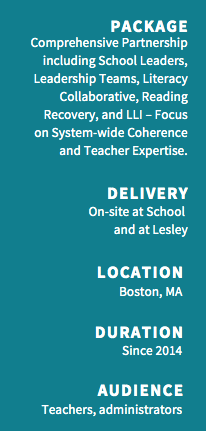
The Channing School’s partnership with the Center for Reading Recovery and Literacy Collaborative began in 2014 when the school was identified by the Massachusetts Department of Education as a turnaround school. Principal Carline Pignato worked closely with CRRLC faculty to develop a comprehensive long-term plan for literacy improvement focusing on improving the knowledge and decision-making expertise of teachers. A school-wide focus on literacy and dedicated teamwork helped Channing exit turnaround status and earn 3rd grade MCAS results that greatly surpassed the rest of the district.
Approach
Channing’s educators invested in a school-wide learning culture by developing expertise and leadership at all levels. CRRLC helped Channing refine their school-wide literacy vision and implementation plan to include embedded and ongoing professional learning with a focus on developing a teacher’s understandings of how to observe and respond to reading behaviors for all students. Center faculty also visited the school frequently to give feedback and support reflection on practices to continue improvement. Reading Recovery and Leveled Literacy Intervention were provided for students who struggle with literacy.
Results
Improvements at Channing have been substantial and sustainable. State test performance allowed Channing to exit turnaround status. The school’s educators take the most pride in knowing they collectively took bold action to prioritize literacy instruction that supports the joy of reading and writing. In the words of Principal Pignato, “Students didn’t need to change. They already had joy in their hearts. We just needed the right tools to teach and lead better in order to help students bring out their joy– and growth follows.”
“Nothing makes our day more than seeing a student immersed in a book of their choice and eager to talk about it with their peers and teachers. However, the literacy outcomes we planned for were not materializing, because as adults, we lacked the deep understanding of the reading and writing processes required in order to ensure that our students would become the lifelong independent thinkers, readers and writers that we envisioned for them.”
– Principal Carline Pignato
Impact
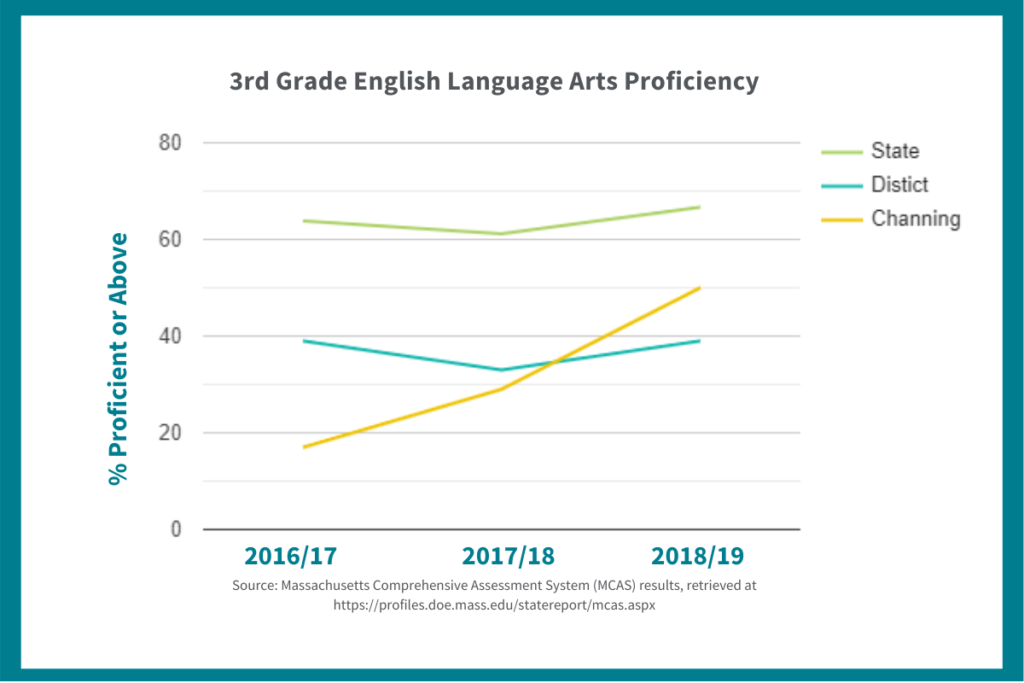
Improvements in state test scores at Channing have been impressive. While the district’s 3rd grade proficiency rates have been stagnant since 2016-17, Channing’s 3rd grade proficiency has accelerated at an incredible rate. While still below state proficiency rates, Channing has outperformed the district and shown a growth rate at more than ten times that of the rest of the state.
Download a PDF version of this case study